Palmetto Bug, Smokybrown or German Roach? Telling Them Apart
Updated 2026-10 · Atlanta, GA
Why the species matters
Every roach plan starts with one question: is it breeding inside, or visiting from outside? Get that wrong and you can spend a season of treatments on the wrong side of the wall. A clear photo next to a coin usually settles it, and the company you call will ask.
The visitors
Smokybrown
About an inch and a quarter, uniformly dark brown to mahogany, glossy. Strong fliers on warm nights. UGA associates them with older neighbourhoods with mature hardwoods, where they live in tree holes, gutters and leaf litter, and notes they are uncommon in new construction. Expect them in intown Atlanta and leafy older suburbs.
American
The biggest, up to about an inch and a half or more, reddish-brown with a pale band behind the head. Lives in sewers, drains, crawlspaces and mulch. Often enters through floor drains and plumbing.
Oriental
Dark, nearly black, shiny, with short wings and slow movement. Prefers cool, damp places such as crawlspaces, basements and drains. UGA lists it among the roaches people loosely call palmetto bugs.
Woods cockroach
A native outdoor roach that lives under bark and in woodpiles. Males fly to lights on spring and summer evenings and blunder indoors, where they die without breeding. They often arrive in firewood.
Asian cockroach
Looks like a German cockroach but lives outdoors in leaf litter and tall grass, flies well and comes to lights at dusk. Established in parts of Georgia since spreading north from Florida.
The resident
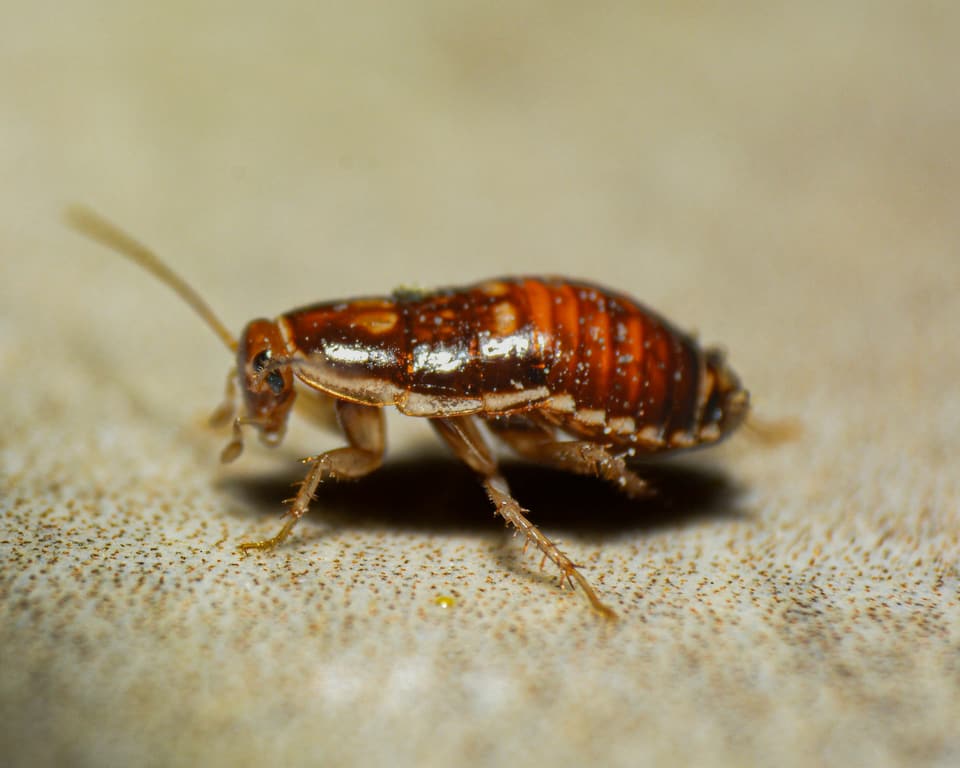
The German cockroach is about half an inch long, tan, with two dark stripes on the shield behind the head. It rarely flies and almost never lives outdoors. You find it in kitchens and bathrooms, under sinks, behind the fridge and stove, inside cabinet hinges and in electronics. Females carry their egg cases until they hatch, which is part of why numbers climb so fast. Seeing one in daylight means many more are hidden. This is the roach that needs a series of baiting visits, not a perimeter spray.
A newcomer worth knowing about
In 2017 a specimen collected in Spalding County, south of Atlanta, was confirmed by the UGA Museum of Natural History as the Turkestan cockroach, the first record of it in Georgia. It is common across the Southwest and lives much like the American and smokybrown, outdoors in moist sheltered places. UGA's Dan Suiter said it is probably in other places in the state that simply have not been reported. If you find a roach that matches none of the above, keep it.
What to do with what you found
Outdoor species: reduce the habitat next to the house, clear gutters, pull mulch back from the foundation, seal gaps under doors and around pipes, screen vents, and ask for an exterior treatment. German cockroaches: stop using sprays and foggers, clean up food and grease, and get a baiting programme with follow-ups.
Call for a cockroach quote. Describe or photograph the roach, say where and when you see it, and a local company will plan the visit around the species.
Where to go next
Common questions
Is a water bug different from a cockroach?
In Atlanta usage, no. Water bug and palmetto bug are both names for large outdoor cockroaches, mostly American, smokybrown and Oriental.
Why do big roaches show up after rain?
Heavy rain floods the drains, mulch and leaf litter where outdoor species live, and they move to higher, drier ground, which is often your house.
Do small roaches mean German cockroaches?
Often, but young American and smokybrown roaches are small too. Look for the two dark stripes behind the head, and note whether you see them in the kitchen or outside.